Flax Engine 1.13 adds DDGI specular reflections, occlusion culling and .NET 10
Flax Engine 1.13 has been released with .NET 10 and C# 14, DDGI specular reflections, occlusion culling and split-screen rendering. Reversed Z depth is on by default, so existing projects should be checked after upgrading.
Digital Developer Desk, 21d ago, 3 min read
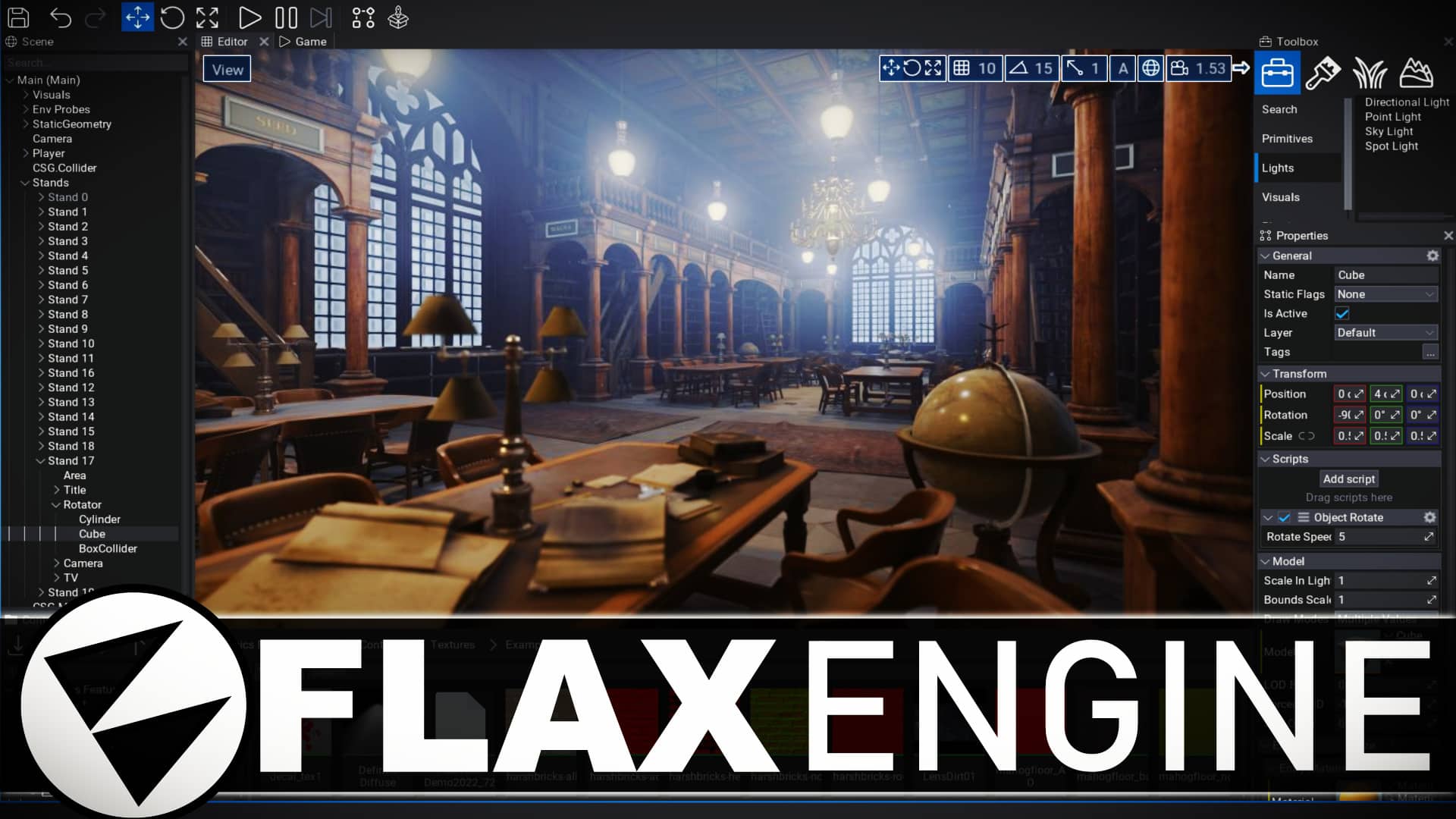
Flax Engine 1.13 is out, according to GameFromScratch. The release moves the engine's base runtime to .NET 10 LTS, which brings C# 14. The report says .NET 8 reaches end of life this year, and that the team showed the new runtime running on Nintendo Switch.
Rendering gets the most changes. DDGI, the real-time global illumination system, now samples and filters better in areas far from probes, which keeps indirect shadowing intact. A new option renders indirect lighting at half resolution with bilateral upscaling. DDGI can also place specular probes so rough surfaces get dynamic reflections without Environment Probes. On the demo level this costs about 49 MB of VRAM and 0.5 to 0.9 ms of GPU time on a 2080 Ti.
Other rendering additions include PCSS soft shadows for point, spot and directional lights, and occlusion culling based on hardware queries and HZB. Culling covers models, particles, terrain, foliage and dynamic shadows, and you can plug in your own methods. Skinned meshes that are identical can now be drawn in one call, and a demo ran 5,000 animated characters at 60 fps. TAAU lets temporal anti-aliasing upscale the image, and the FSR plugin now targets AMD FSR 4.
Flax can now render multiple viewports into the main window, each with its own GUI region, for split-screen local co-op. A racing sample built on the Arizona Framework shows it with multiple HUDs. A new Online Platform sample covers player avatars, achievements and friends lists, and uses new IOnlinePlatform features for overlay UI and rich presence. On desktop, games now switch audio output automatically when the player changes devices.
Tooling changes include a search field in the properties panel, a rebuilt wireframe debug view, resizable nodes, and a GPU memory profiler that can preview and save resources. Behavior Tree decorators show condition text colored by result in play mode. Scripting gains ScriptingObjectInterfaceReference<T> for referencing objects by interface in C++ and C#, and RenderToTextureControl can apply a custom material shader to rendered UI.
Before upgrading, note that Reversed Z is on by default. The depth buffer now runs from 1 to 0, which improves precision at distance and large-world rendering, so custom shaders or depth-dependent effects are worth testing. The source is a third-party report, so check the official Flax 1.13 release details for full notes. The roadmap lists Flax 1.14 for Q1 2027 and 1.15 for Q3 2027, with 2.0 targeted for late 2027 and full backward compatibility as the aim for moving projects over.
Sources
Get the daily brief
The five stories that matter, every weekday morning. Free.
Artist breaks down game-ready Napoleon flintlock pistols at 18,990 triangles
3D environment artist Aliaksandr Beliakouski has published a production breakdown of Napoleon's flintlock pistols as a game-ready prop, covering blockout, baking and texturing. The asset uses 18,990 triangles and a single 2048x2048 texture set.
80.lv4h ago3 min read

BeamNG.drive on PS5 keeps its PC soft-body physics, team says in interview
In an interview with 80 Level, the BeamNG team said the PS5 version of BeamNG.drive runs the same soft-body simulation as PC. They also described memory and performance work and a rebuilt UI and controls for gamepad play.
80.lv19h ago3 min read

Escape from Tarkov's Terminal map: how Battlestate built a permanent night port
Battlestate Games described how it built Terminal, the final location in Escape from Tarkov, in an interview with 80 Level. The developers covered night-only lighting, a lens flare fix now used on every map, and a custom culling system.
80.lv2d ago4 min read
